What AI reading assistants actually do
Most tools sold as an AI reading assistant are really delegation tools: the model reads so you don’t have to. That is sometimes exactly what you want — and it is a different product from helping you read.
What this piece argues
- Most AI reading tools replace the reading rather than assist it
- A summary tells you what the model said the text said
- Delegation is rational for triage; it fails for the texts that matter
- An assistant that improved the reader, not the ingestion, remains largely unbuilt
The phrase “AI reading assistant” now covers two products that point in opposite directions. One sits beside you while you read and tries to make the reading go better. The other reads instead of you and hands back a précis. Nearly everything currently sold under the name is the second kind, and the difference is worth stating plainly, because only one of them ends with you having read anything.
The category as it currently stands is easy to describe. Summarisers compress a document into bullet points. Chat-with-your-PDF tools let you interrogate a file and get answers with page references. Reading copilots sit in the margin offering explanations, translations and takeaways. The engineering varies; the shape does not. A document goes in, a shorter and more convenient artefact comes out, and the value on offer is time — specifically, the time you would otherwise have spent reading.
There is nothing dishonest in that. Delegated reading is old. Executives have had briefing papers for as long as there have been executives; scientific papers have carried abstracts for a century; every barrister who ever instructed a junior was outsourcing reading. What the models changed is the price. Delegation used to require another person, so it was rationed. Now it costs nearly nothing, so it is becoming a default — and a default deserves examination in a way a luxury never did.
Two products wearing one name
The line between the two products is simple to draw. A tool that helps you read leaves the text in front of your eyes and leaves the comprehension work in your head; it changes the conditions of reading — pace, layout, spacing, sound — while you do the thing itself. A tool that reads for you performs the comprehension elsewhere and delivers the result. The question that separates them is blunt: when you finish using it, have you read the text? Not absorbed its gist, not become able to discuss it — read it.
Run familiar tools through that question and the category sorts itself. A spacing control is assistance. A voice that follows along under the words is assistance — the words are still yours to take in. A summariser is replacement, however good the summary. A chat interface is replacement with a search feature attached. None of this is a verdict on quality. It is a classification, and buyers deserve to know which side of it a product sits on before any money changes hands.
The naming matters because “assistant” imports a claim. An assistant implies you are still the one doing the work. Much of the category would be more honestly described as an agency — you commission a reading and receive a report. Agencies are useful. But an agency that calls itself an assistant is borrowing the credit of work it did for you, and the borrowing shows up later, when you discover what you do and do not actually know.

The provenance problem
Here is what changes when the model reads instead of you. Before, you knew what the text said — imperfectly, partially, in your own flawed way, but by acquaintance. After, you know what the model said the text said. Everything you now believe about the document has travelled through one extra hop, and the hop is not neutral. Compression keeps conclusions and drops reasoning. It keeps claims and drops hedges. It smooths a writer’s emphasis into an even paste of information, which is precisely what makes it readable in thirty seconds.
The usual objection is accuracy: models misstate, invent, skip. That is real, and it is improving, and it is also not the point. A perfectly faithful summary would still leave you one hop removed, holding testimony rather than acquaintance. For a meeting agenda this is nothing. For a contract, a diagnosis, a paper you intend to build on or an argument you intend to oppose, the hop is exactly where the substance lives. The longer version of this argument is made in summaries are not reading, and it predates the models by some decades.
There is a second-order effect worth naming, and we flag it as our own reasoning rather than a finding. Reading skill behaves like other skills: it is maintained by use. A reader who delegates the hard texts for a decade has spent a decade not practising on hard texts. Nobody has measured what that does to the underlying capacity — the models are too new — but the shape of the worry is familiar from every other assistive technology, and it would be strange if reading alone were exempt.
A summary is testimony. Reading is acquaintance.
The provenance problem, in one line
When delegation is rational
It would be convenient for us to declare delegation a vice, and it would be false. There are cases where handing the reading to a model is plainly the right call, and an honest account of AI reading apps has to list them — because a reader who knows when to delegate reads better than one who never does. The skill is triage, and triage is older than the tools.
- Triage. Forty documents, one afternoon, and a decision about which three deserve real reading. A summariser used as a sieve costs you nothing you were going to keep.
- Texts you would never have read anyway. A summary of a report that would otherwise have gone wholly unread is a gain, not a loss — the alternative was zero.
- Refreshing. You read the book years ago; the model’s précis reactivates what is already yours. The acquaintance happened. This is maintenance.
- Navigation. Asking a 300-page manual where the relevant section is, then reading that section yourself, uses the model as an index — the oldest respectable reading technology there is.
- Machine-written prose. Text generated at almost no cost arguably invites reading at matching cost; we take that unsettling question up in when the machines write everything.
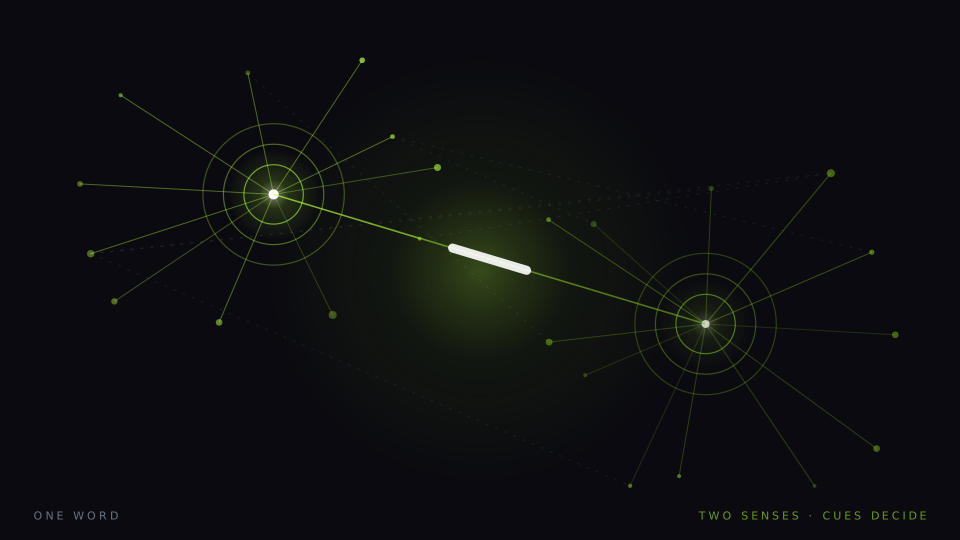
There is also a concession we owe. We are not standing outside the machinery pointing in. Our own app runs software that makes semantic guesses about your text — a resolver that scores context cues to decide whether bank means the river or the loan, then picks an icon by sense. That is a model of a kind, sitting very close to the words. The distinction we defend is not machine versus no machine. It is whether the machine positions itself between you and the text, or beside you while you face it.
The assistant that would deserve the name
What follows is our own speculation, marked as such. An AI reading assistant worth the second word would spend its intelligence before and after your reading, and hold its tongue during. Before: it might gloss the vocabulary you are about to meet, surface the structure of an argument, tell you where the difficult stretch is so you can slow for it. After: it might test you — genuine retrieval practice, questions with plausible distractors — because being tested on material is one of the few interventions with solid evidence of improving retention. During: silence.
Pacing is the other opening. Our app already stretches dwell time on long words, punctuation and numerals — a crude, rule-based sensitivity to difficulty. A model could in principle predict difficulty properly: this clause is dense, this paragraph is load-bearing, slow down here. Whether that would make stronger readers or merely dependent ones, nobody knows, and we mean that literally — nobody has tested it, including us. It is the experiment we would most like to see run, and it is a bet, not a finding.
The market will not build this on its own, because “read less” is an easier sale than “read better”, and the second product takes years to prove while the first demonstrates itself in a demo. So apply the blunt test yourself, to anything sold as an AI reading app, ours included: where does the time it saves come from? If it comes out of everything around the reading — the finding, the triaging, the checking afterwards — it is an assistant. If it comes out of the reading itself, it is a substitute, and you should at least know that is what you bought.
A note on what this is. Signal is written in-house by the team that builds Reader Inc., so treat it as an argument rather than a review. Nothing here is medical, psychological or educational advice, and the app is not a treatment, therapy or diagnosis for any condition. Where we describe research we describe it in general terms; where we are reasoning past the evidence we say so. The app is free, runs entirely on your own device, and ships with a comprehension test switched on — which means you can check every claim we make against your own reading rather than taking our word for it.
Read next

When the machines write everything
The cost of producing plausible prose has fallen close to zero. The volume arriving at every desk rises, the value per page falls, and the scarce thing stops being writing. It becomes attention that has actually been paid.
Summaries are not reading
The machine summariser is the newest member of the speed-reading family and the most seductive, because for triage it is often the correct tool. It is also somebody else’s compression, and compression is a series of judgements you never get to see.
Semantics on the device
A neural voice with 82 million parameters already runs inside this browser tab. The question is whether a model that understands word sense can join it — offline, inside a 150-millisecond frame, without a download nobody would accept.