Reading after
Stroke, brain injury, MS, the fog reported after some cancer treatments, long COVID, ordinary ageing. Different mechanisms entirely, with one thing in common: someone who read comfortably now finds it work.
What this piece argues
- Acquired reading difficulty is several different problems wearing one description
- Hemianopic reading difficulty breaks the return sweep, which is the thing a fixed point removes
- When fatigue is the limit, the honest measure is cost per page, not words per minute
- Rehabilitation is led by a clinical team; a free web page is not a programme
There is a sentence people use after a stroke, or a course of treatment, or a bad year of relapsing multiple sclerosis. They rarely say that reading has become difficult. They say they are not a reader any more. The skill and the sense of self have come apart somewhere, and the loss gets filed under the second heading rather than the first. That is worth taking seriously before any of the mechanics.
The conditions gathered in this article do not belong together medically. A lesion in the left occipital lobe, a demyelinating plaque, the cognitive fog many people describe during and after cancer treatment, the persistent cognitive complaints reported after some COVID infections, and the ordinary slowing that arrives with age are different mechanisms, with different trajectories and different clinical answers. Grouping them is defensible for exactly one narrow purpose: at some point each of them can turn reading, which used to be automatic, into effortful work. That is the only thing this piece assumes about you.
It matters a great deal which kind of work. “Reading is harder now” is not one complaint; it is at least five, and they call for different responses. Naming them separately is not pedantry. The wrong tool aimed at the wrong difficulty is worse than no tool at all, because it costs an afternoon and leaves behind the impression that nothing helps.
Five different broken things
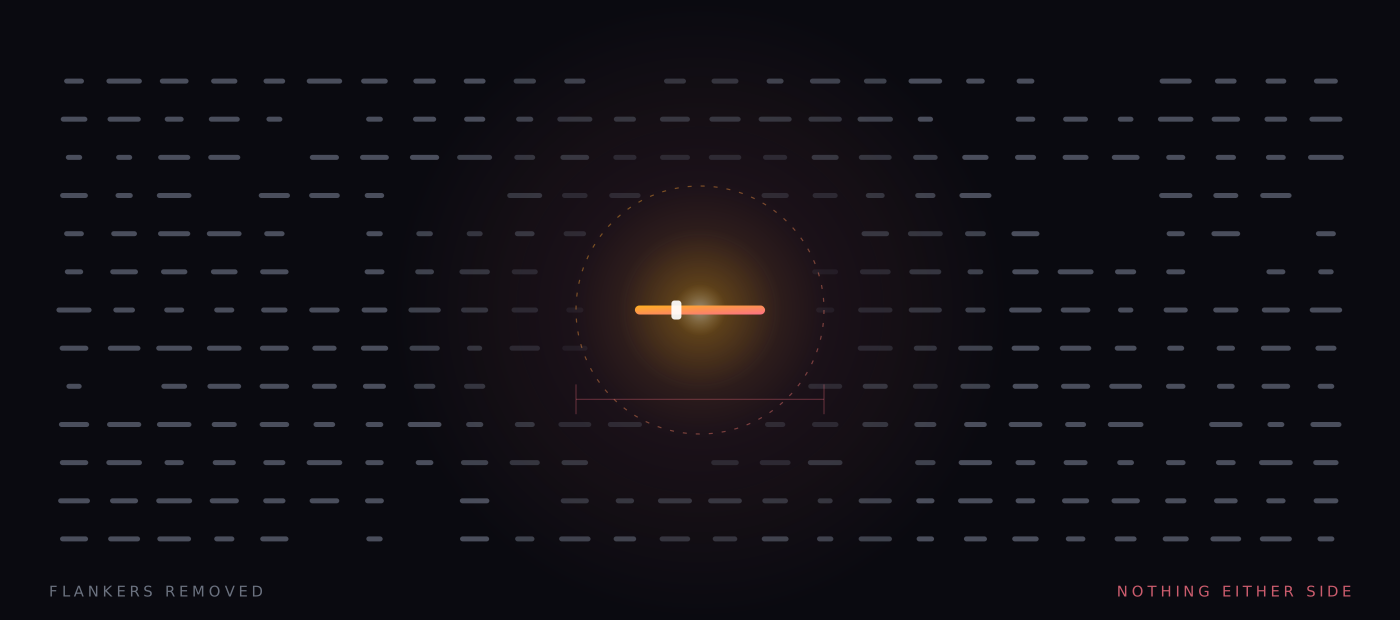
Damage to the visual pathway can remove a field of vision on one side of both eyes. When the missing field is on the side a reader is reading into, the specific thing that breaks is not word recognition and not comprehension. It is the sweep — finding the next word, and above all landing accurately at the start of the next line. Hemianopic reading difficulty is well described in the rehabilitation literature and is worked on by specialists using specific strategies and training. It is also the one item on this list where single-point presentation is aimed precisely at the mechanism: there is no sweep to make, because there is one place and the word comes to it.
Pure alexia is stranger and more specific. A person can write a sentence and then be unable to read back what they have written; letter-by-letter reading often survives, laboriously, and word length starts to predict how long a word takes. It is a disconnection between vision and the word form, and it is managed by clinicians who know the presentation. We raise it here because it makes the general point better than any argument could: reading is not one function, so “a reading app” cannot be one answer.
Aphasia affects language itself — word retrieval, comprehension, sometimes grammar — and the written and spoken channels can be affected differently in the same person. Here we want to be unambiguous. Speech and language therapy is the thing that changes outcomes in aphasia. It is a clinical discipline with a serious evidence base, delivered by people trained to assess an individual profile and work against it over months. A free web page is not in that category and never will be. What an image paired with a word can offer, at most, is a second route to a meaning when the word is not coming — and whether that is useful for a particular person is a question for that person and their therapist.
Fatigue is the dominant limiting factor for a great many people with multiple sclerosis, and it is the recurring theme in first-hand accounts of cognitive fog during and after cancer treatment, and in long-COVID-associated cognitive complaints. The reading difficulty here is frequently not a difficulty with the first paragraph at all. It arrives on the fourth page. So the useful question is not how fast someone reads. It is what a page costs them, and how many pages there are before the day’s budget has gone.
And then ordinary cognitive ageing, which is not a disease and should not be described as one. Processing speed declines gradually across adult life and working memory capacity changes with it; that much is well established. Vocabulary and accumulated knowledge frequently do not decline at all, which is why an older reader can find a long subordinate clause effortful while understanding the argument better than anyone else in the room. Those two facts are usually reported as one story, and they are not one story.
The question is not how fast you read. It is what a page costs you.
Fatigue, stated as a budget
Mechanisms, offered as hypotheses
Everything that follows is the same shape of argument, and it is worth stating the shape before the content. Here is a mechanism the app has. Here is what is known about that mechanism in general. Here is why it might matter for a particular difficulty. And here is how to find out for yourself, in ten minutes, at no cost, on your own material, on your own machine. None of the middle steps is evidence about you. Only the last step is.
The word arrives at a fixed point, so there is no return sweep and no line to track. Rate goes as low as you want it — plenty of readers run this at 120 to 180 words per minute, well below an ordinary rate, purely for the fixed point — and dwell stretches automatically up to 2.8× on long words, commas, sentence ends and paragraph breaks. Every word is paired with an icon chosen by sense rather than spelling, which is a second route to meaning when retrieval is unreliable. The voice runs on the same clock as the display, so hearing and seeing cannot drift apart. All animation scales to zero on one slider, and a system reduced-motion setting silences it unasked. And the remaining time is shown honestly throughout, so the end of the passage is always in sight.
That last one sounds cosmetic and is not. When fatigue is the constraint, an unbounded task is a different task from a bounded one. A wall of text has no visible floor; a stream has a stated remaining duration, and knowing that a passage will end in four minutes is what makes it possible to decide whether to spend the four minutes. We think that matters more than pace does for a lot of readers. We have not measured it, and we are not going to pretend otherwise.
| What changed | What the app does | What we cannot claim |
|---|---|---|
| A visual field loss on the side you read into | One word, one fixed point. No return sweep to execute and no line to find | That it restores a field of vision, or substitutes for hemianopic reading training with a specialist |
| Word retrieval is unreliable | Every word paired with an icon chosen by sense; a sense can be pinned in a personal lexicon | That it treats aphasia, or does any part of what speech and language therapy does |
| Reading tires you long before it defeats you | Rate as low as you need, dwell adjustable, remaining time shown so the end is visible | That it reduces fatigue, or that pacing a passage affects the underlying condition |
| Screens and movement make you unwell | One slider scales all 28 animation primitives to zero; reduced-motion is honoured automatically | That we can predict who this happens to, or that low motion makes rapid presentation suitable for everyone |
| Processing is slower than it used to be | Speech and display share one clock, so the voice never runs ahead of the word | That practice at speed improves processing speed, or that any of this is cognitive training |
Where this is the wrong tool
Take that caution literally, because we mean it as a list rather than as legal cover. Motion sensitivity is common after brain injury, and vestibular disturbance is a real and unpleasant thing rather than a preference; the motion slider exists for that reason, but a person who finds moving screen content nauseating may find that scaling animation to zero is still not enough, because the word changing at all is the motion. Visual attention disorders can make a single item at a fixed point harder rather than easier. And because words in a stream vanish, rapid presentation removes re-reading by construction, which is precisely the wrong property when working memory is the thing that changed. There are step-back keys and a restart, and on some days they will not be sufficient.
We would rather say all of that than have someone spend a fortnight fighting an interface that was never going to suit them and conclude that the problem was their brain. The general argument for the presentation, along with the parts of it that run against us, is set out on the science page. The specific case about crowding and decoding, which is a different population and a different mechanism, is in decoding is not comprehension.
Cost per page
If you want to test this properly, do not test speed. Speed is the wrong dependent variable for almost everyone in this article. Take a passage of your own — real material, not a demo text, and not something chosen to flatter the result. Read it the way you currently read, and take the recall check at the end. Then read a matched passage in the stream, at whatever pace feels sustainable rather than impressive, and take the check again. Write down both scores, and write down something the app cannot measure: how you felt afterwards, and whether there was anything left in the tank for the next page.
The recall check mixes words that genuinely appeared with plausible distractors, and it is capable of telling you that your comprehension fell. It does that quite often. That is the point of shipping it switched on rather than as an optional extra — a reading tool that cannot produce a result unfavourable to itself is not measuring anything. Sessions export as plain text, so the comparison survives past the afternoon you made it, which matters when the thing you are actually tracking is whether a good week and a bad week look different.
None of this restores anything. The word arriving at a fixed point does not repair a visual field, and an icon chosen by sense does not give anybody their vocabulary back. What the arrangement can do, at best, is change the presentation of the text so that a bit less of the effort goes into the mechanics and a bit more is left for the meaning. Whether that happens for you is not something we know, and it is not something we could know from here. The app is free, needs no account, uploads nothing, and works offline, which means the entire cost of finding out is ten minutes and a page you already wanted to read.
A note on what this is. Signal is written in-house by the team that builds Reader Inc., so treat it as an argument rather than a review. Nothing here is medical, psychological or educational advice, and the app is not a treatment, therapy or diagnosis for any condition. Where we describe research we describe it in general terms; where we are reasoning past the evidence we say so. The app is free, runs entirely on your own device, and ships with a comprehension test switched on — which means you can check every claim we make against your own reading rather than taking our word for it.
Read next
Reading, listening, and the third thing
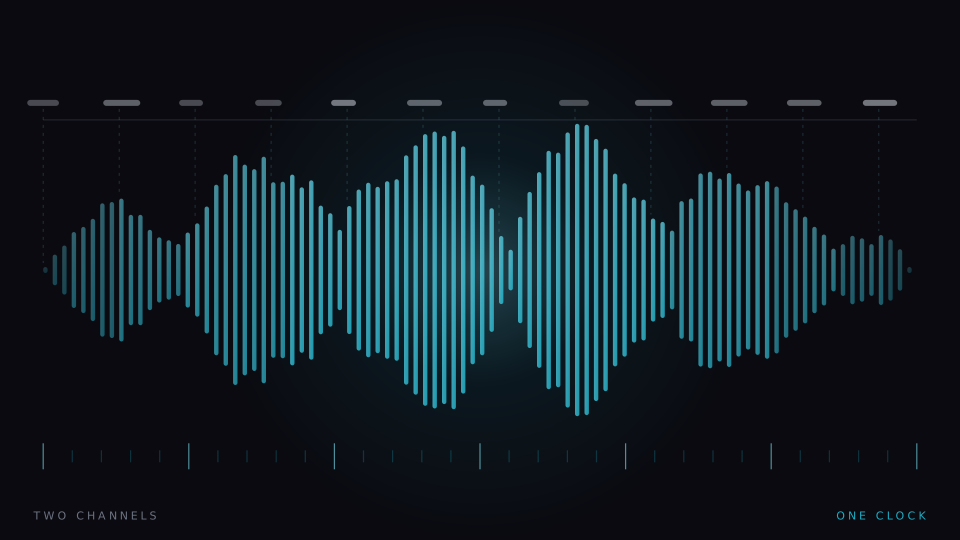
Text-to-speech is the fastest-growing branch of the speed-reading family, and the fair thing to say about it is that it wins some arguments outright and loses others badly. Here is which — and what happens when you lock the two together.
Pictures before words
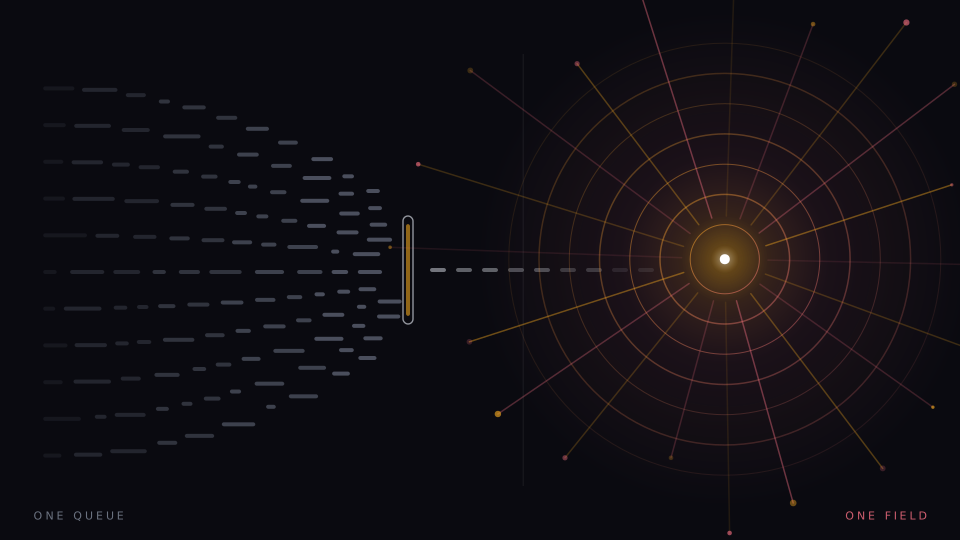
For a great many readers the picture is not a decoration on the text. It is the primary channel. There is a serious, decades-old tradition of building for those readers, and we are standing downstream of it.
What we will not claim
The accessibility market has a long habit of shipping confidence ahead of evidence. We sell a reading app, so the habit is available to us too. This is the list of sentences we have decided not to write.