Reading tools for dyslexic adults
Most dyslexia software is designed for children in classrooms. Adults with reports to finish and degrees to earn need something else. A survey of reading tools for dyslexic adults — what each one buys, and where the evidence stops.

What this piece argues
- Tools make today's text easier; instruction changes reading ability — keep the claims apart
- Text to speech is the best-supported general-purpose tool for adults
- Spacing does most of what special typefaces are usually credited with
- Single-word presentation is promising on mechanism and untested with dyslexic readers
Search for dyslexia tools and you will find phonics games, classroom posters and advice addressed to parents. Useful, all of it — and almost none of it aimed at the adult who has a report due on Friday, a statute to get through, or a degree being finished at night. Dyslexia does not end at eighteen. The software conversation mostly does, and this piece is about what is left for the adults.
The adult case differs from the school case in ways that matter for choosing tools. There is no teacher and no timetable. The reading volume is not negotiable — the contract is the length it is. Text arrives in fixed and often hostile formats: scanned PDFs, dense email chains, forty-page policy documents. And the goal is usually throughput this week, not skill-building this term. Many dyslexic adults have spent years assembling private workarounds; the tools below are mostly those workarounds, made systematic and given batteries.
Plenty of adults also arrive here without a formal identification. Widespread screening in schools is historically recent, so a good number of people simply grew up finding reading harder than it seemed to be for everyone around them, and adapted quietly. Nothing in this article requires a diagnosis to try. Everything in it costs at most an afternoon to test on your own documents, which is the only test that applies to you.
One distinction organises everything else here. A tool changes the text in front of you — reads it aloud, spaces it out, presents it differently — and makes today’s reading easier without changing you at all. Instruction, in the structured-literacy sense, aims to change reading ability itself, and it is slower, harder and more valuable. Both are legitimate. Almost every misleading claim in this market comes from selling one while implying the other.
Tools change the text; instruction changes the reader
Dyslexia is a specific learning difficulty affecting accurate and fluent word recognition, decoding and spelling. Commonly quoted prevalence estimates run somewhere around five to ten per cent of the population, with wide variation by definition and by language. What it is not is a deficit of intelligence, and it is not a deficit of comprehension when the language arrives by ear. That last property is not a consolation prize. It is the mechanical fact most of the tools below are built on.
For an adult who wants the underlying reading changed, structured literacy instruction with a specialist is the honest recommendation, and no piece of software is a substitute for it. But instruction operates on the scale of months, and most adult reading operates on the scale of Thursday. Tools are the right category for Thursday. The rest of this piece takes them in order of how well the evidence supports each — which is not the order the marketing would choose.
Text to speech, the workhorse
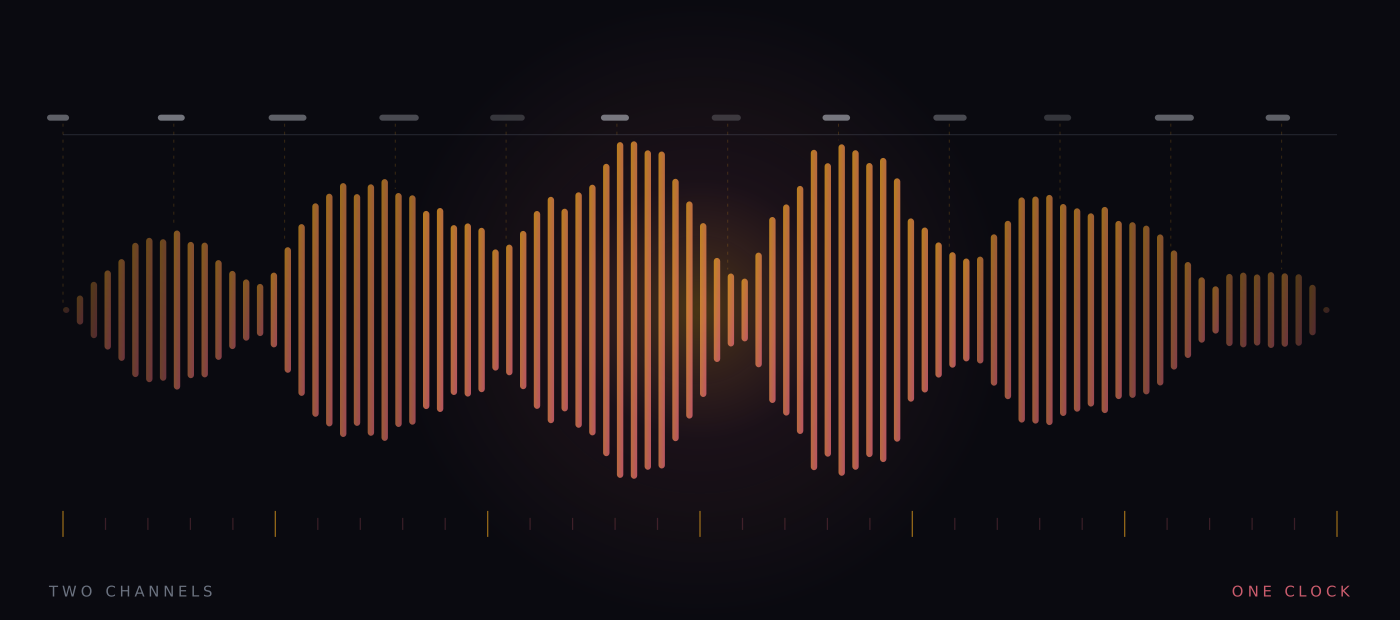
If decoding is the bottleneck and comprehension by ear is intact, then a tool that turns print into speech routes around the difficulty rather than fighting it. That is text to speech, and for adults it is the closest thing this field has to a default answer. It handles arbitrary documents, it works at the volume a job demands, and it asks nothing of the reader beyond a pair of headphones. We have set out the full case, including the question of where the voice should run, in text to speech as a reading tool.
Two honest limits. First, listening is not decoding practice: a decade of text to speech will make you excellently read-to, and it will not, by itself, make print easier next year. Second, quality varies enormously, and the failure mode is subtle — a flat or garbled voice taxes the ear just enough that a long document becomes its own ordeal. A third point is really a bonus: hearing your own writing read back is one of the most reliable proofreading methods a dyslexic adult can use, because the ear catches what the eye forgives.
Spacing and typography
The strongest ordinary visual intervention is also the least glamorous: push the letters and the lines apart. Increased spacing directly targets visual crowding — the interference of neighbouring letters with the one you are trying to recognise — and it has been found to improve reading speed and accuracy in dyslexic children with no training involved. The studies are mostly on children; the mechanism is a general property of human vision. Nearly every serious reading surface now ships a spacing control, and it should be the first switch an adult reaches for.
Dyslexia-specific typefaces are the better-known intervention and the weaker one. They are sincerely made and many readers genuinely prefer them, but controlled comparisons have generally not shown them outperforming a well-spaced ordinary sans-serif. The likely reading is that most of what they deliver is spacing and weight, which any decent app can apply to a font you already like. Preference still counts — comfort is worth something on its own terms — and the fuller argument is in our piece on dyslexia-friendly fonts.
Audiobooks, the oldest tool
Before any of this software existed there were human beings reading books onto tape, and for long-form prose a good human narration is still the standard synthetic voices are measured against. Prosody, pacing, the pause that tells you a paragraph has ended — narrators do all of this without being asked. The limits are coverage and format: the audiobook catalogue is a fraction of the print catalogue, workplace documents are never in it, and you cannot linger on the one sentence that matters without fumbling for a slider. For books, start here. For everything else, text to speech exists precisely because a narrator cannot follow you to work.
Single-word presentation, stated carefully
The tool this magazine’s publisher makes presents text one word at a time at a fixed point — a technique called RSVP — and the mechanical case for it in this context is easy to state. A single word with empty field on every side has no neighbouring letters to crowd it, no line to track, and no place on the page to lose. For a reader whose difficulty includes any of those things, that is a structural change to the display, not a styling choice.
And here is what we cannot say. Nobody has tested this presentation with dyslexic adults — not us, not anybody we know of — so the mechanism is an argument, not a result. RSVP also takes something away: because each word replaces the last, you cannot glance back, and glancing back is precisely what a reader does when a sentence fails to land. Whether that trade favours you is an empirical question about you, which is why the app ships a recall check rather than a promise.
The tools that work do not fight the difficulty. They route around it.
The pattern, stated plainly
What to try first
- Turn on text to speech for the documents you already have to read this week. Every mainstream operating system ships a workable voice at no cost, and the experiment takes an afternoon.
- Raise letter spacing and line spacing anywhere you read regularly, until the page looks slightly too airy, and see whether it gets easier. Keep whatever helps, everywhere the setting exists.
- For books, take the audiobook first and drop the guilt entirely. The ideas do not know which channel they arrived by, and comprehension is the product either way.
- If curiosity survives all that, run a passage through the app at a modest pace and take the recall test at the end — then decide with a score in hand rather than an impression.
The order is deliberate. It runs from the best-evidenced tool to the least, and from the cheapest experiment to the most unusual. Most adults will find that the first two steps, together, change more than they expected — a voice for the long documents and a roomier page for the rest covers a large share of a working week. The later steps are refinements, and refinements are allowed to fail.
The pattern across all four tools is the same, and it is worth ending on. None of them fights the difficulty; each routes around it, getting decoding out from between an intact mind and a page of text. An adult who assembles two or three of them is not cheating, any more than glasses are cheating. The report gets read, the ideas arrive, the degree gets finished. That was the assignment. And when a product asks you to believe more than that, we keep a set of questions worth asking in choosing a reading app for dyslexia.
A note on what this is. Signal is written in-house by the team that builds Reader Inc., so treat it as an argument rather than a review. Nothing here is medical, psychological or educational advice, and the app is not a treatment, therapy or diagnosis for any condition. Where we describe research we describe it in general terms; where we are reasoning past the evidence we say so. The app is free, runs entirely on your own device, and ships with a comprehension test switched on — which means you can check every claim we make against your own reading rather than taking our word for it.
Read next

Choosing a reading app for dyslexia
Any reading app for dyslexia is making claims the moment it names its audience. Five questions separate the honest tools from the wishful ones — and because fairness demands it, our own app answers them last.
Text to speech as a reading tool
Dyslexia is a difficulty with decoding, not with thinking — which is why a synthetic voice can hand a reader their own comprehension back. What text to speech reading does well, what it cannot practise, and why where the voice runs matters.
Decoding is not comprehension
Dyslexia is a difficulty with word recognition, decoding and spelling. It is not a difficulty with thinking. That distinction decides which tools are honest, which are useless, and what a presentation setting is entitled to claim.