The second channel
Most reading tools treat pictures as ornament. In this one the picture is structural — it is there to carry the load that the inner voice drops when the words start moving too fast to pronounce.
What this piece argues
- Dual coding and picture superiority are among the sturdiest findings in memory research
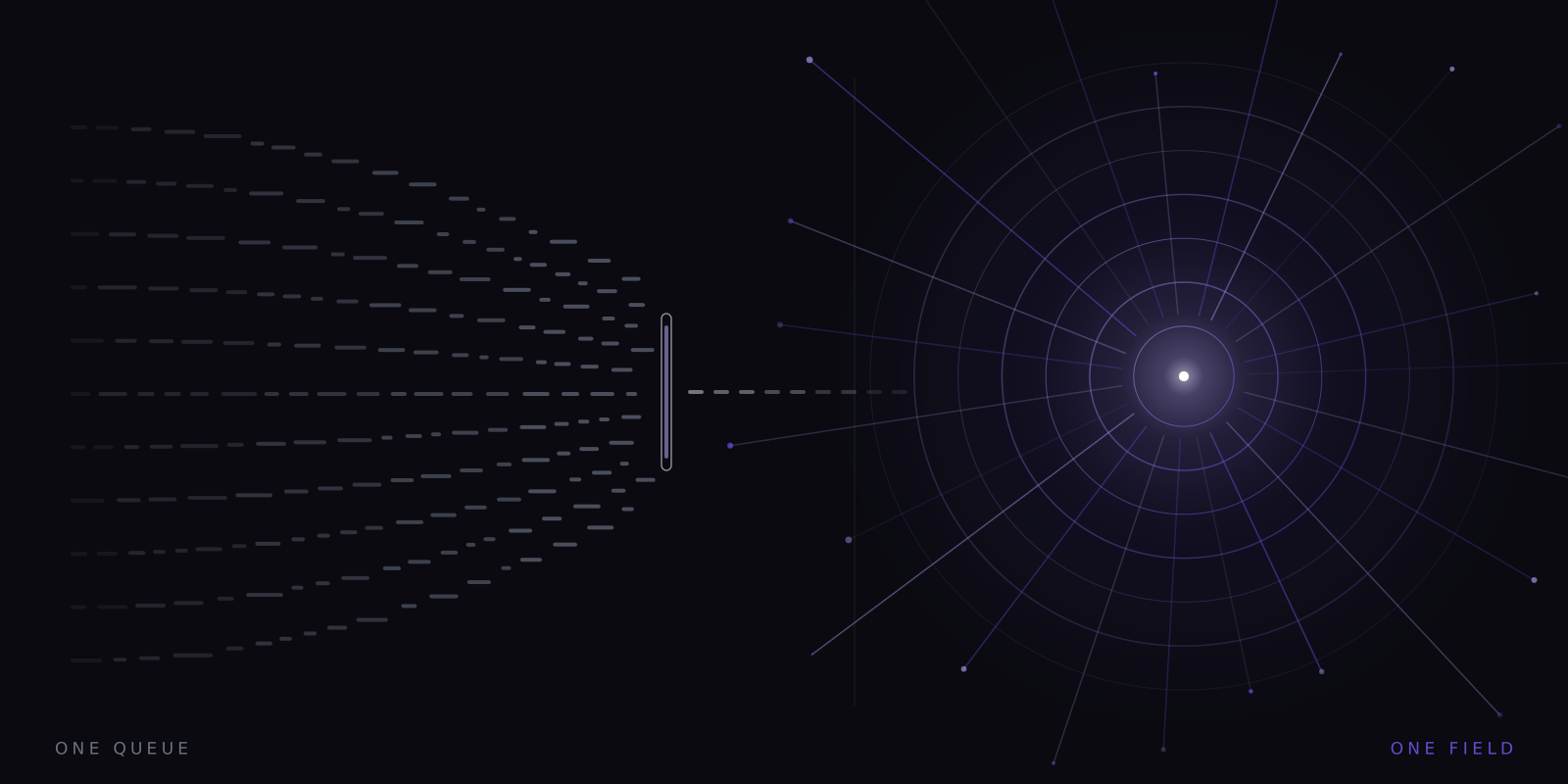
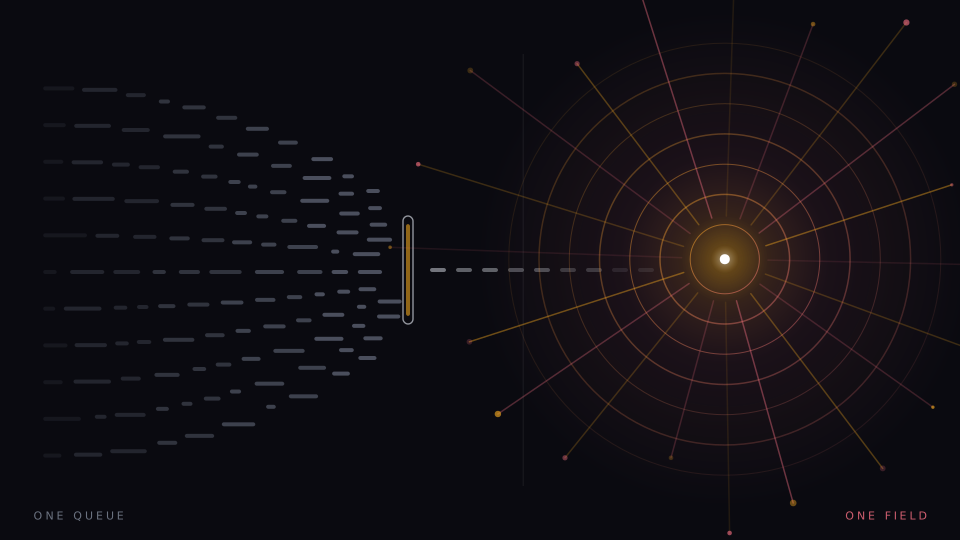
- Language arrives as a queue; an image arrives as a field, all at once
- Above roughly 400 wpm the inner voice falls away and something must replace it
- An image near the word rather than of its sense is worse than no image
Put an icon beside a word and most people read it as decoration — a small friendly thing to soften a screen. That is not what it is doing here. The image is load-bearing. Take it out and the rest of the app is an ordinary word-flasher with a nice typeface, and the comprehension curve behaves exactly the way it behaves for everyone else.
The evidence underneath this is old, dull and extremely well replicated, which is the best kind. Verbal and imaginal codes are partly separable systems that can refer to each other. Material encoded both ways is remembered better than material encoded either way alone. And pictures are recalled better than their names — the picture superiority effect, one of the most reproducible results in the memory literature, demonstrated so many times and in so many forms that arguing about whether it exists is no longer an interesting use of anyone’s afternoon.
There is a corollary that matters more for reading than the headline does. A concrete word like river activates both codes on its own; an abstract word like criterion mostly activates one. That asymmetry is exactly why concrete words are consistently easier to recall — they arrive with two retrieval routes rather than one. Which raises an obvious question that nobody in the speed-reading business seems to have asked: what happens if you supply the second route deliberately, for every word, including the ones that would never have generated an image by themselves.
A queue and a field
Here is the shape of the argument, and we will mark clearly where it stops being research and starts being ours. Language reaches you as a queue. Symbols in sequence, decoded one after another, at roughly the pace your inner voice permits — that is the whole reason reading rate and speaking rate sit so close together across the population. Nothing about the eye enforces that pace. The channel does.
A picture is not delivered that way. You apprehend it as a field: the whole thing lands, and the parts are available more or less simultaneously rather than in a decreed order. That distinction is our framing, not a citation — the underlying research talks about separable codes and separate working-memory stores, not about queues and fields. But the framing is what the product is built on. If meaning can arrive through a route that does not have to wait behind the sentence, then the queue stops being the only path into the reader, and the ceiling that ends most speed-reading claims is no longer the only ceiling in the room.
It is worth saying what everyone else in this field is doing, because they are not doing anything foolish. Spritz and the tools built on the same idea optimise where the eye lands inside the word, so the recognition point never has to be hunted for. Bionic Reading weights the opening letters of a word to give the eye a firmer handhold. Both are careful pieces of design and both address the queue — how efficiently symbols get through the narrow door. What none of them does, as far as we can tell, is open a second door. That is the only respect in which this app is unusual, and it is also the respect in which it is least proven.
The substitution argument
The strongest version of the case is not that images are a bonus. It is that they are a replacement for something you lose on the way up. Subvocalisation is real, measurable as activity in the speech musculature, and it is not a defect to be trained out. It supports comprehension, particularly on difficult material. Suppressing it works, and it costs you something — the phonological route was doing genuine work while it was there.
Push past roughly 400 words per minute and the question becomes moot, because there is simply no longer time to say the words to yourself. The inner voice does not need to be suppressed at that pace; it falls away on its own. And that is the moment the interesting problem appears. A route that was carrying real comprehension load has just gone quiet, and the standard speed-reading answer is to hope nothing was lost. We think something was, and that the honest response is to put something else in its place.
Our bet is imagery. An image is an unusually direct way of activating a concept, because it does not pass through the word form at all — no letters, no phonology, no articulation. If the phonological route was helping to bind words into propositions, an imaginal route arriving on the same clock is at least a plausible candidate to take over part of that job. The word arrives, the picture of its sense arrives with it, and the reader has two traces instead of one at exactly the speed where they had dropped to zero.
- The queue
- Letters to phonology to meaning, in order, at a pace tied to articulation. Fine at 250 wpm. Structurally unavailable above about 400.
- The field
- A sense-chosen mark, apprehended whole. No decoding step, no ordering constraint, and no dependence on how the word is spelled.
- The substitution
- As the first route thins out with speed, the second is supposed to carry more. That trade is our reasoning, not a measured result.
The inner voice does not need suppressing at speed. It leaves. The question is what replaces it.
The substitution argument, in one line
Where the evidence stops
Everything in the first half of this article is well established. What we do with it is not. Dual coding was demonstrated with words and pictures presented at ordinary study rates, not with an icon arriving for 250 milliseconds and then vanishing. Picture superiority was shown with photographs and line drawings of things, not with a compact single-stroke glyph resolved automatically from a sentence. Nobody has run the combination we ship, at the speeds we ship it at, with the kind of images we use — including us.
There are three separate places that could break, and they are worth naming rather than blurring together. A 250-millisecond exposure may be too short to build an imaginal trace worth having. An icon may be too impoverished to function as a picture in the sense the research means. And the two channels may interfere rather than complement, in the way that identical printed and spoken text can interfere. Each of those is an empirical question with a real chance of going against us.
The failure mode
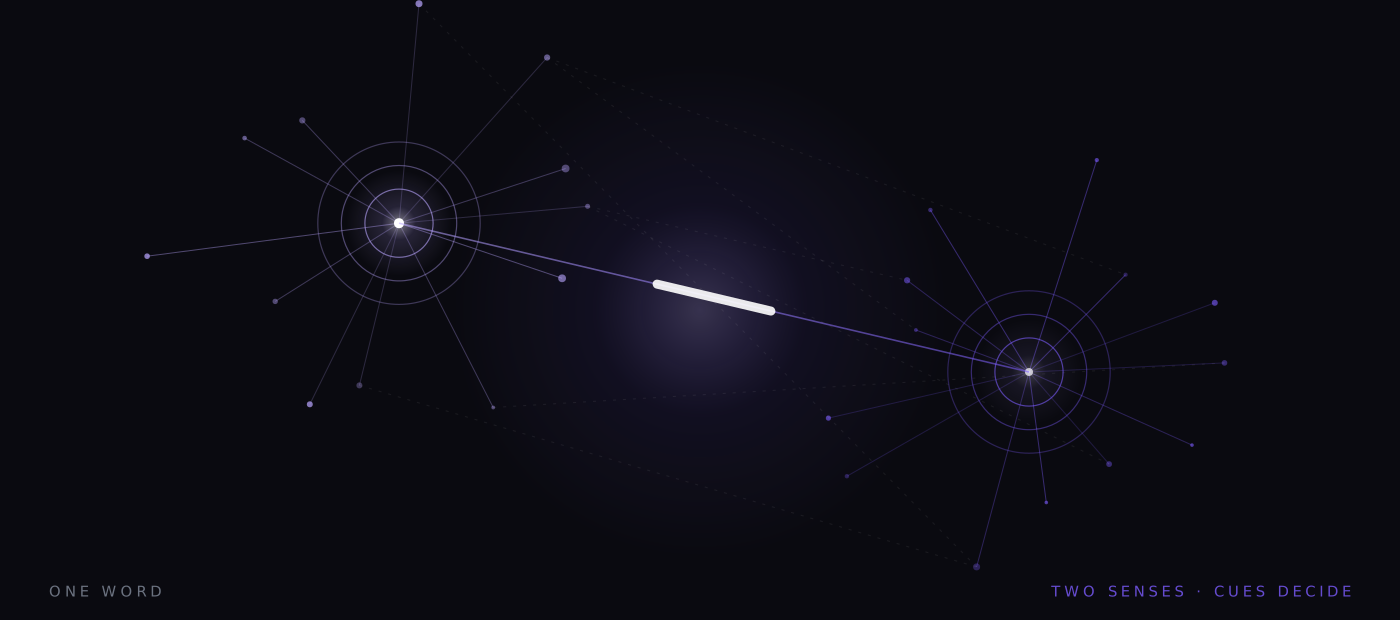
There is one way this goes badly wrong, and it is not the way people expect. The danger is not a missing image. It is a nearly-right one. An image that is merely near the word rather than of its sense does not sit politely in the background failing to help. It competes. It activates a concept the sentence did not mean, at the exact moment the reader is trying to assemble a proposition, and it does so through a channel that is unusually good at getting concepts activated quickly.
So the arithmetic is asymmetric. A correct image might add a modest amount. A wrong image can subtract a great deal, and it can do so invisibly, because nothing in the reading experience announces that a meaning was injected from the side. You may carry the wrong sense forward for three sentences before the text contradicts it hard enough to notice, and by then the repair costs more than the image ever saved. That is why sense disambiguation is the hinge the whole thing turns on, and why getting bank right is the hardest engineering problem in the product rather than a footnote about a picture dictionary.
How to find out for yourself
The app gives you eight pairing modes for a reason: we do not know which one works, and neither does anybody else. Icon above the word is the neutral starting point. Icon flashing before the word is a deliberate test of whether pre-activating the sense helps. Icon replacing the word entirely turns the stream into pure meaning and is either revelatory or useless depending on the reader. Word only is there so you can turn the whole argument off and see what happens.
That last mode is the important one. Run a passage with the second channel closed, take the recall check, then run a matched passage at the same pace with it open and take the check again. Same pace both times — the question is whether comprehension moves, not whether speed does. The app stores both scores and exports them, and it has no view about which way the comparison should come out. If the second channel does nothing for you, the report will say so in plain text, and that is a more useful thing to own than another page of confident prose.
A note on what this is. Signal is written in-house by the team that builds Reader Inc., so treat it as an argument rather than a review. Nothing here is medical, psychological or educational advice, and the app is not a treatment, therapy or diagnosis for any condition. Where we describe research we describe it in general terms; where we are reasoning past the evidence we say so. The app is free, runs entirely on your own device, and ships with a comprehension test switched on — which means you can check every claim we make against your own reading rather than taking our word for it.
Read next
Let the word come to you
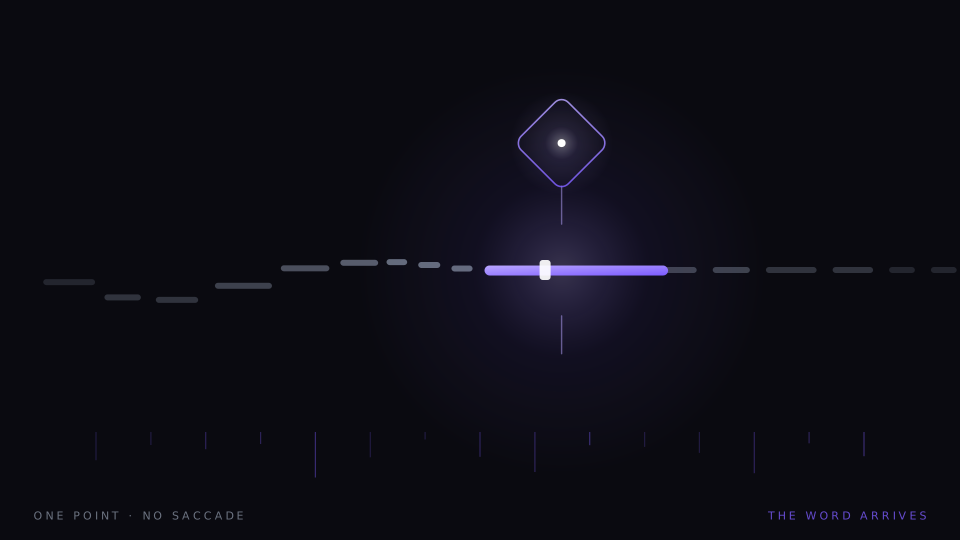
Word-by-word presentation removes eye movement completely, and eye movement is a real cost. It is also a much smaller cost than the speed-reading industry needs it to be. Here is the arithmetic, with nothing rounded up.
Two banks, one word
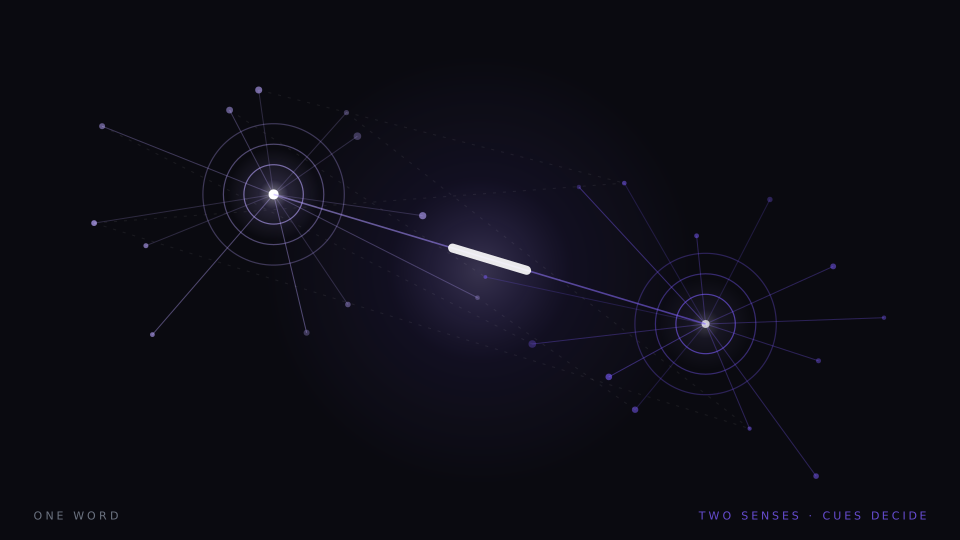
Every image in the stream depends on a decision made in a quarter of a second: which sense of this word did the sentence mean. Get it right and nobody notices. Get it wrong and you have injected a meaning that was never there.
Pictures before words
For a great many readers the picture is not a decoration on the text. It is the primary channel. There is a serious, decades-old tradition of building for those readers, and we are standing downstream of it.