Reading through glass
Every attempt to put continuous prose in a headset has been miserable, for reasons that live in the optics and the retina rather than the software. Reading in AR may need a page-less format — though nobody, including us, has tested one at scale.
What this piece argues
- Continuous prose fails on glass for optical reasons, not software ones
- Vergence conflict, narrow fields of view and live backgrounds all punish text
- A single word at a fixed point sidesteps most of what makes glass hostile
- None of this is tested at scale, and we say so throughout
Every few years a headset arrives, and with it the demonstration where a newspaper floats in the air. The demonstration always works and the habit never forms; nobody reads long prose in glass, not because nobody has tried but because everyone who tries stops. The failures are consistent enough to be interesting, and they are mostly not software failures. They live in the optics, in the retina, and in a background that will not hold still.
We should say immediately what this article is: informed speculation from the Futures desk, not a product announcement and not a claim of evidence. We build a reading format that happens to match the constraints of glass unusually well, which makes us exactly the wrong people to trust on the subject and exactly the right people to lay the argument out for inspection. Every claim below about headsets specifically should be read as untested at scale, because it is.
Why prose on glass has been terrible
Start with vergence. In natural viewing, the eyes’ convergence and the lenses’ focus move together: look at something near, and both adjust in step. In most headsets and smart glasses the display sits at one fixed focal distance while content pretends to sit at others, so convergence and focus are pulled apart. That mismatch — the vergence–accommodation conflict, well documented in the vision literature — is tolerable for glancing and gaming, and notoriously wearing for the fine, sustained fixation that text demands.
Then the field of view. Smart glasses in particular offer a usable display window measured in a couple of tens of degrees at best, often less, and frequently off-centre. Continuous text needs lines, lines need width, and width is exactly what the optics cannot give. Squeeze a paragraph into the window and you get short, choppy lines and constant rewrapping; let it run wide and the reader must move their head, which turns the stillest activity in daily life into a neck exercise.
The background is alive. Optical see-through glass draws text over the world — a world with its own contrast, motion and clutter. Letters over a passing bus, a patterned wall or a face have lost the uniform, high-contrast ground that print takes for granted; whether the interference is crowding proper — the flanker effect we examine in the crowding problem — or ordinary contrast masking, the letters pay for it. Print solved this five hundred years ago with a boring, blank, motionless page. Glass un-solves it.
Motion completes the set. A page in the world must be anchored somewhere — either to the world, where every head turn drags it across the retina and any tracking lag smears it, or to the head, where it sits fixed in the visual field like a smudge on spectacles. Neither anchoring has yet produced comfortable long-form reading, and the failure is instructive: prose needs its ground to behave like paper, and the one thing glass cannot supply is stillness underneath the text.
The precedent on the wrist
This situation has a precedent. The smartwatch posed the same puzzle in miniature: a display far too small for lines of text, strapped to a person who still wanted to read on it. The approach that fitted best there was serial presentation — a word or a few at a time, at a fixed point — because when a display cannot give you width, it can still give you time. We walked through that story in reading on the wrist, and the wrist matters here because it is, on our reading, the one consumer surface where RSVP-style presentation found a natural home rather than a demonstration.
The watch also taught the honest limits. Nobody reads novels on a wrist; they read messages, glanceable passages, the occasional article in a pinch. Serial text on a tiny display is a format for minutes, not hours, and there is no reason yet to expect glass to be different. A format for minutes can still matter — most reading occasions are minutes — but the claim must be sized to fit. The precedent argues that one-word reading suits constrained displays; it does not argue that anyone wants to live there.
When the display cannot give you width, it can still give you time.
The wrist’s lesson for glass
Why one word might fit
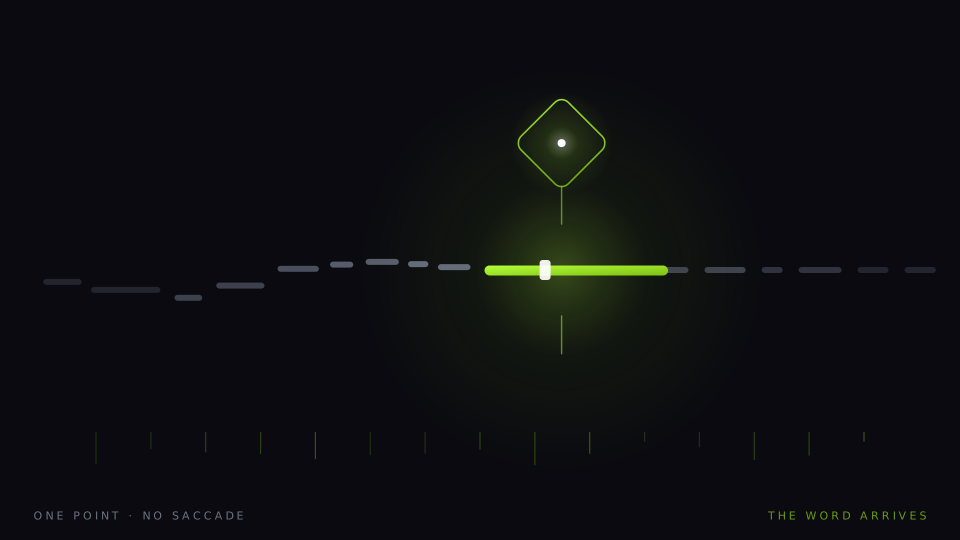
Now the fit, point by point, as hypothesis rather than result. A single word at a fixed point needs almost no field of view — it is the one text format that gets better as the window shrinks, because there is nothing to wrap and nowhere to look but the point. It involves no head movement and no line tracking. It can sit at one screen position and one apparent depth, letting the eyes hold a single vergence posture instead of hunting across a layout that fights the optics at every line break.
Against the live background, the format can defend itself in ways a page cannot. One word can carry a small local backing — a dim panel behind just that word — without walling off the world the way a floating page must. Our pairing modes even suggest options no page has: icon behind the word, word alone, icon alone. Whether a paired icon helps or harms against a moving background is precisely the kind of question we cannot answer from a desk, and we are not going to pretend otherwise.
The rhythm engine travels too. Dwell that stretches on long words, commas and sentence ends was designed for a browser tab, but nothing about it assumes one, and a pace that breathes with the sentence may matter more in glass, where the reader cannot lean on layout for structure because there is no layout left.
And there is the voice. In glasses, audio is native — speakers or bone conduction sit millimetres from the display — and our speech channel already runs fully on-device, which matters twice on a face-worn computer: once for battery and connectivity, and once because a device that sits near a camera and also uploads everything you read is a privacy proposition nobody should accept. A voice that never leaves the device stops being a slogan on a face computer; it becomes the minimum standard of decency.
What would have to be true
For reading in AR to become ordinary rather than demonstrated, our list runs roughly so: optics that hold text sharp and stable at a fixed apparent depth for twenty minutes without complaint; a social answer to reading while apparently staring through the people in front of you; input as effortless as a page turn — a ring, a wheel, gaze dwell — for pause and for the scrub backwards that must stand in for re-reading; and a reason to read there at all, rather than on the excellent glass rectangle already in everyone’s pocket.
That last item is the one that decides it, and it is not technical. The phone did not beat the book on display quality; it beat it on being already in the hand. Glasses win reading only in the moments when hands and phone are unavailable — mid-task with both hands occupied, on a treadmill, flat on your back in a hospital bed. Whether those moments add up to a habit or merely a feature is a question the next ten years will answer; our running guesses sit in the next decade of reading machines.
Our position, stated once and plainly: glass is the first display since the watch whose constraints point towards the format we build rather than away from it. That is either an early signal or a coincidence, and the intellectually honest odds are not far from even. What we can promise is the same accounting we give the format everywhere else — recall next to speed, costs next to gains — because a word floating on the world is still a word that vanishes, and everything we have ever written about what vanishing costs comes to glass along with us.
A note on what this is. Signal is written in-house by the team that builds Reader Inc., so treat it as an argument rather than a review. Nothing here is medical, psychological or educational advice, and the app is not a treatment, therapy or diagnosis for any condition. Where we describe research we describe it in general terms; where we are reasoning past the evidence we say so. The app is free, runs entirely on your own device, and ships with a comprehension test switched on — which means you can check every claim we make against your own reading rather than taking our word for it.
Read next
Reading on the wrist
A watch face is forty millimetres of glass and the worst reading surface ever mass-produced — unless you only ever show one word. Here is the concept, and the four things that would have to be true before we built it.
The next decade of reading machines
Forecasts about reading technology usually describe the screen and forget the reader. Here is an attempt at the opposite — one constraint that will not move, five that will, and the only frontier we think is worth competing on.
The end of the page
Every reading interface since the codex has traded away something the page did quietly well. Before anyone declares the future of reading, somebody should write down what the page actually does — because we sell the thing that deletes it entirely.